“Where are you? Umva, we’ve started!”
The message lit up my phone.
Outside my room’s window, the rain fell steadily through the fronds of a tall palm tree. The hills of Kigali had vanished behind low clouds, and somewhere in Kinyinya, my colleagues were already gathering, having driven there, dry and warm, for something most of us had never had: a pottery experience.
Two of them had planned it and announced the news in our WhatsApp group. We all agreed on the date and time: Saturday, 26 September, at three o’clock. When the hour arrived, I was still at home. The rain kept falling.
I didn’t have a car, so I waited for the sky to change its mind.
The longer I waited, the more my doubts grew. One came with a reminder that I usually spend my weeks with screens, documents, and deadlines, and that my hands type but do not build. I pictured my clay collapsing in front of people I would face again on Monday. Maybe I should just stay home. I thought. The rain gave me a perfect excuse.
But almost an hour later, the pelting on the roof faded, then stopped. I looked out again. The palm stood still, and a patch of blue had opened over the hills. I decided to go.
I pulled on my outfit: grey trousers, a black T-shirt, and a denim jacket. I went out to find a bike. The air had that sharp, after-rain cold. It slipped under my sleeves and settled on my skin. Puddles shone on the road. The city smelled of wet soil and vehicle smoke.
The ride to Kinyinya took twenty-seven minutes. Wind hit my face, and cold crept into my arms. I felt every kilometre, yet somewhere along the way, my doubt began to loosen. A freshly washed city makes you feel you are heading toward something cool, even before you know what it really is.
I reached Kigali Pottery Café around half past five, two and a half hours late. A row of cars stood outside. Decorated trees lined the entrance. I paid the motard, rubbed the cold from my hands, and walked in.
The finished work greeted me first. Shelves of glazed pottery glowed under the lights in blue, white, and grey. I saw vases waiting for flowers and round-bellied pots. Grey sugar containers sat in a line, as if someone might come for tea. I found it hard to believe each one had started as a lump of wet clay in someone’s hands. Within the hour, I might be one of those someones.
A few metres further in, I found the studio. Black hand-painted letters ran across its white tiled wall: Pottery Experience. Beneath them, in looping script, a single word: Throwing. Wooden stools stood beside the wheels. At the back, rows of unfired jugs and bowls waited their turn.
And there were my colleagues.
I almost didn’t want to interrupt them. They bent over their wheels, hands wrapped around spinning clay. Nobody checked a phone or talked about work. I knew these people mostly through emails and meetings. Now they sat absorbed, their faces soft in a way I rarely saw in the office. Excitement sparked in me, and I forgot the cold road.
One of them looked up and smiled. “You made it!”
“The rain sha,” I said.
She laughed and handed me an apron. Someone had made it from kitenge, a bold check of yellow and black. I tied it on. I was no longer the late arrival who had waited out the rain. I was dressed for the work.
The instructor, a man in a blue coverall, came over. He moved calmly, like someone who had done this a thousand times and still enjoyed it. He set up my station: a wheel, a round wooden board on top, a block of clay, and a bowl of water.
“What do you want to make?” he asked.
I looked around.
“A vase,” I said, grinning. “The one whose top is shaped like a heart.”
“That’s okay,” he said.
I braced myself to begin work.
“There is a pedal on your right,” he continued. “Press it with your foot gently so it can rotate.”
I did as instructed.
He began to make a vase so I could see. His hands moved without hurry, the clay rising between them as if it already knew its shape. First, a round belly, then a narrowing neck, and then a gentle lip. The work looked effortless and thrilling. I would soon learn that difficult things always look that way in a master’s hands.
Then it was my turn. I pressed the pedal as he had shown me, and the wheel rotated.
“Wet your hands,” he said. “Keep the clay soft. If it gets dry, the shape will break.”
I dipped my hands in the water. That was the first lesson. To keep the clay soft, my hands had to keep returning to the water. I set the clay on the board, and the wheel began to hum.
The first touch surprised me. The clay felt cool and slippery. It pushed back with a will of its own. When I pressed too hard, it wobbled. When I pressed too gently, nothing happened.
“Slowly,” the instructor said, leaning in. “Let the wheel do the work.”
He guided me. Press here to centre the clay. Push your fingers into the middle to open it. Pull the walls up. Open your hands to widen the shape. Squeeze gently to draw it in. Slowly, the lump became a cylinder. Then the cylinder swelled into a belly.
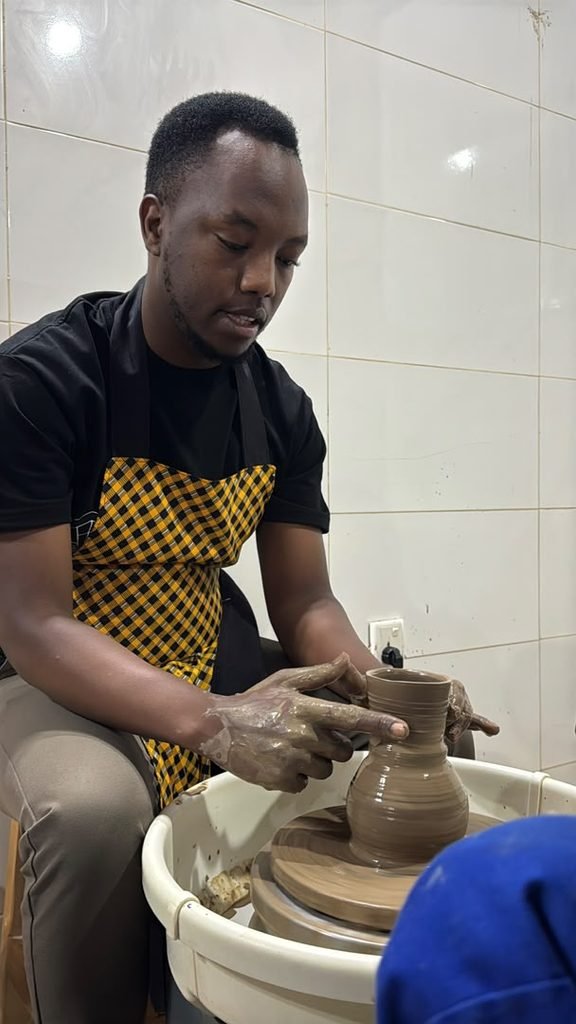
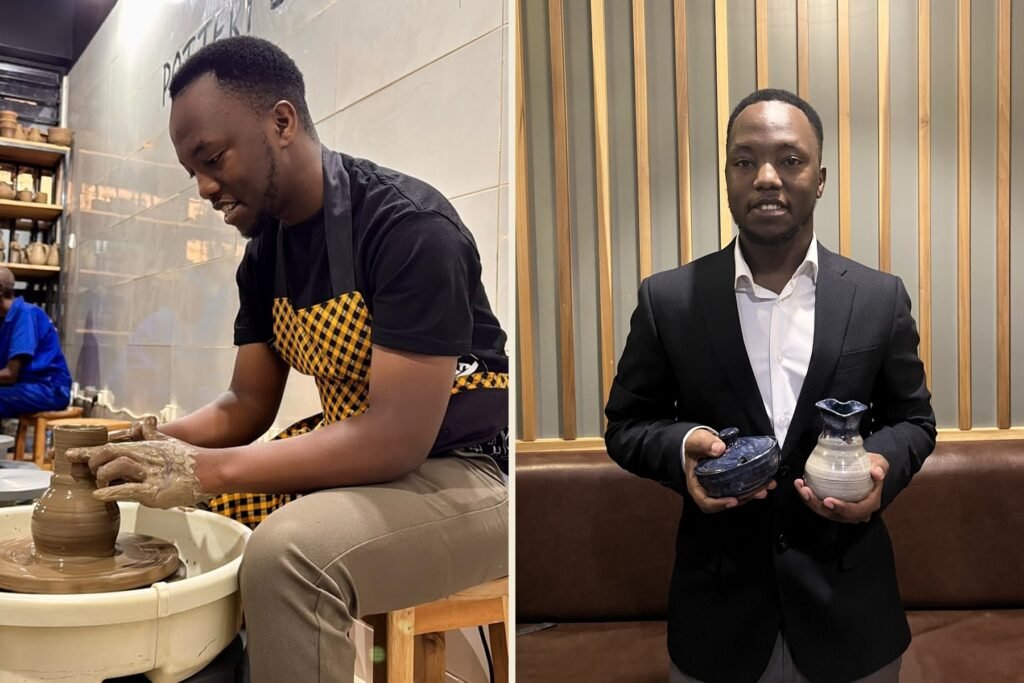
Clay soon coated my fingers and crept past my wrists. My fingertips left fine rings along the sides. With a thread, I pressed thin lines of design into the body of the vase. For almost twenty minutes, nothing existed except the hum of the wheel, the water, and the turning clay.
I finished the vase and held it up on its board for a photograph, beneath that word on the wall: Throwing.
“Is this really your first time?” a colleague asked.
“Yes bro,” I said. I couldn’t stop smiling.
Next came a sugar container, the same shape I had admired on the way in. To make it, I used the same water, wheel, and patience, but my hands moved with less fear now.
Somewhere in the middle of it, I noticed how I felt. Calm. Happy. Light. My mind didn’t drift to work or the cold ride. It stayed awake, but only here, curious how the clay would answer each movement of my hands. I had arrived unsure whether I would enjoy this. Now I didn’t want it to end.
But it did. The instructor showed me the drying rack, where fresh clay hardens before it meets the fire. We set my two pieces there, side by side.
“Your name?” he asked, pen in hand.
“Patrick.”
He wrote it beneath them. My name, in ink, under two shapes that hadn’t existed an hour earlier. Such a thrill!
My colleagues had finished before me and had left the studio. I paid, and the staff told us the pottery would come back in a few weeks, fired and glazed.
I stepped out into the evening. My hands still smelled faintly of earth.
***
Almost two weeks later, the café sent our pieces back together, in brown paper bags stamped with its name. A pink note on mine carried the date of that rainy Saturday, 26/09/2026, and beneath it, Patrick (2 pieces).
“Open it,” a colleague said, leaning over my desk. “Let’s see.”
I unwrapped it slowly, the way you open something you fear might disappoint you. But it didn’t.
The fire had changed the vase. Its body was now a pale grey-white, dotted with tiny dark specks. The rings from my fingertips still showed under the glaze. Deep blue had run down from the neck, with streaks of purple and brown where it had thinned. The heart-shaped lip looked gentler than I remembered, more like a wave. The sugar container shone a glossy blue. A small round knob sat on top of its lid, beside a little notch for the spoon.
“You made that?” the colleague asked.
“Of course!” I grinned.
The pieces weren’t perfect, but they were mine.
That evening, I took pictures again. In one, I hold both up and grin, in my suit and white shirt. The same hands that clay had coated now presented what it had become. In another, I simply point at the vase: I made this.
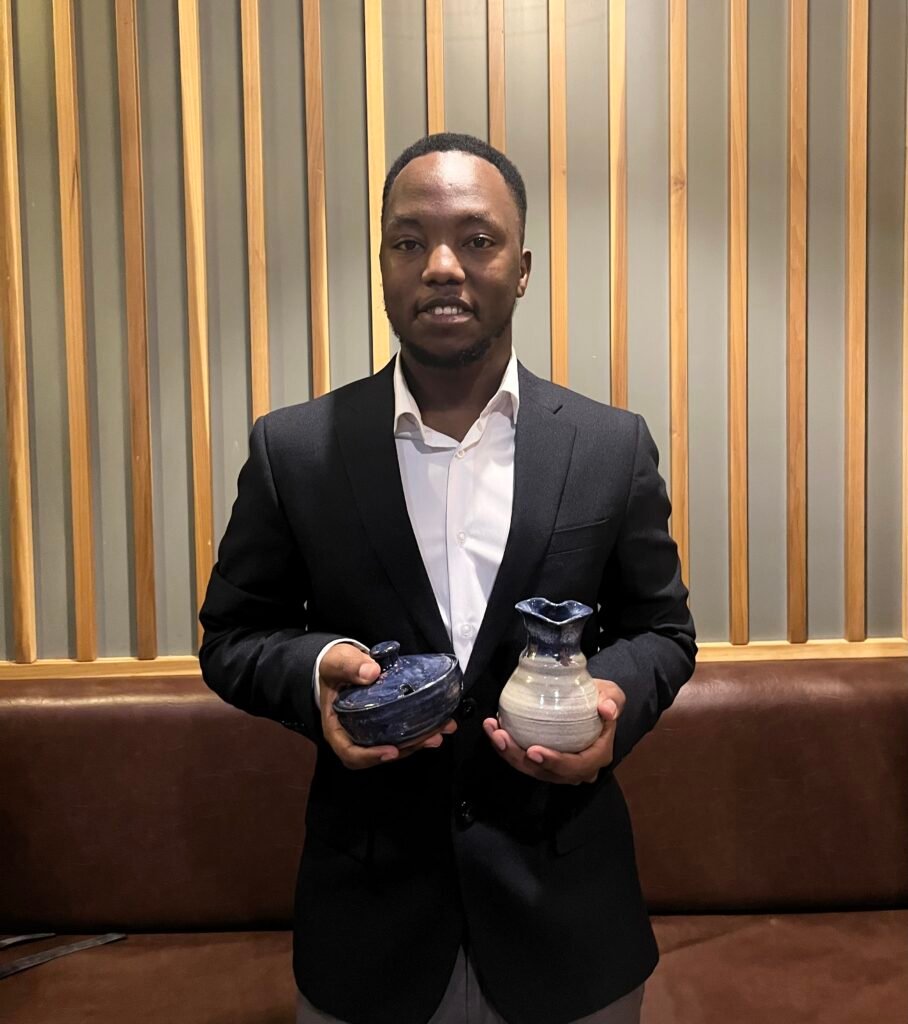
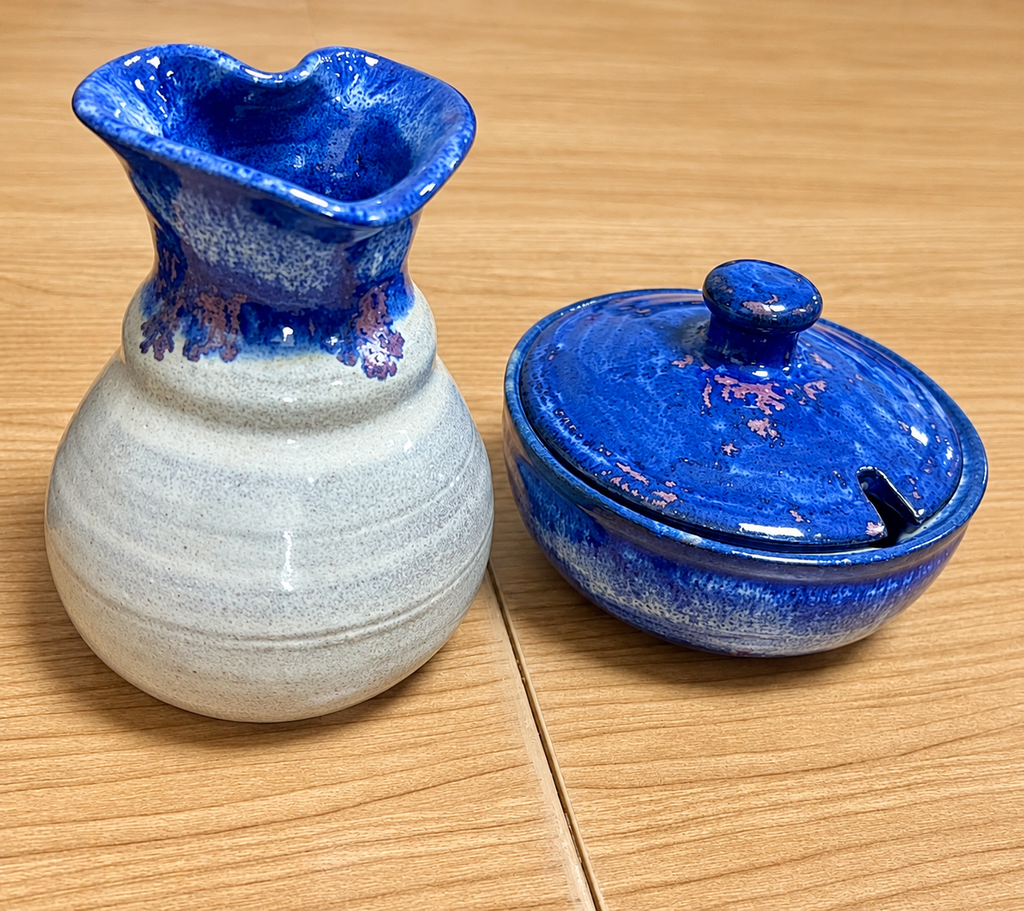
The pieces sit in my home now. When I look at them, I remember the rain, the cold road, and the kitenge apron. I remember my colleagues lost in their work and the instructor’s hands guiding mine. I won’t pretend I made them alone, but the time, the focus, and the hands returning to the water, again and again, were mine.
I nearly stayed home that day. I would have missed more than the pottery. I would never have learned that I can still surprise myself.
I think about the clay now when I hesitate. It doesn’t become strong by staying soft forever. The potter shapes it, then it dries, and then it goes through the fire. Only then can it hold flowers or sugar for years.
And maybe people aren’t so different. Maybe some of the best things begin on a grey morning, when we are not sure we want to go, and go anyway.